AI vs Google Translate vs DeepL for Discord Chat
Classic machine translation or AI? How Google Translate, DeepL and LLMs handle Discord slang, gaming jargon, tone and context, and when AI is worth it.
On this page
- What's the difference between machine translation and AI translation?
- Why is Discord chat so hard to translate?
- Side by side: how each approach handles chat
- Classic engines vs AI translation: comparison table
- Google Translate vs DeepL vs Microsoft: does the engine matter?
- What iTranslator offers on each plan
- When is AI translation worth paying for?
- How to get better translations with any engine
- FAQ
For clear, complete sentences, classic machine translation engines like Google Translate, DeepL and Microsoft Translator are fast, cheap and accurate. Where they struggle is everything that makes Discord feel like Discord: slang, gaming jargon, abbreviations, casual tone and one thought split across three quick messages. AI translation with a large language model (the technology behind ChatGPT) handles those much better, but it's usually slower and can cost more.
This guide explains the difference in plain terms, shows illustrative examples of where each approach breaks down, and helps you decide which one your server actually needs.
What's the difference between machine translation and AI translation?
Neural machine translation (NMT) is what Google Translate, DeepL and Microsoft Translator have been built on for years. These models learn from huge collections of sentences paired with their human translations, and they do one job: take a sentence in one language and produce it in another. They're very fast, cheap to run, and predictable. The same input gives the same output.
LLM translation uses a general-purpose large language model, the kind behind ChatGPT, and asks it to translate. Because these models learned from an enormous amount of informal text and follow instructions, they can be told "this is a gaming server, keep it casual" or be given the previous messages as context. They tend to translate the meaning rather than the words.
The line between the two is blurring. DeepL launched a translation-specialized LLM in July 2024, and in December 2025 Google brought Gemini models into Google Translate to handle idioms and slang better, starting in the U.S. and India. Google, DeepL and Microsoft also now offer LLM-based translation options to developers. So in this article:
- Classic engine means fast, sentence-by-sentence neural machine translation, the way most translation bots use Google, DeepL or Microsoft: one message at a time.
- AI translation means a ChatGPT-class model translating with instructions and context.
Why is Discord chat so hard to translate?
A news article or a product manual is the ideal input for machine translation: complete sentences, standard grammar, one idea at a time. Discord chat is the opposite:
- Slang and memes that change every few months, in every language.
- Gaming jargon, where ordinary words mean something specific: tank, pull, carry, kite, proc.
- Abbreviations like brb, idk and wdym, and their equivalents in other languages (mdr in French, vc and hj in Brazilian Portuguese).
- Tone: friends talk casually, and many languages must choose between a formal and an informal "you".
- Fragments: people type one thought as three quick messages, so each message alone is missing context.
- Names: characters, items, guilds and usernames that happen to be real words and shouldn't be translated at all.
A classic engine sees each message on its own and translates what's written. An LLM has a much better chance of recognizing what the message means in context. That's the whole difference, and the examples below make it concrete.
Side by side: how each approach handles chat
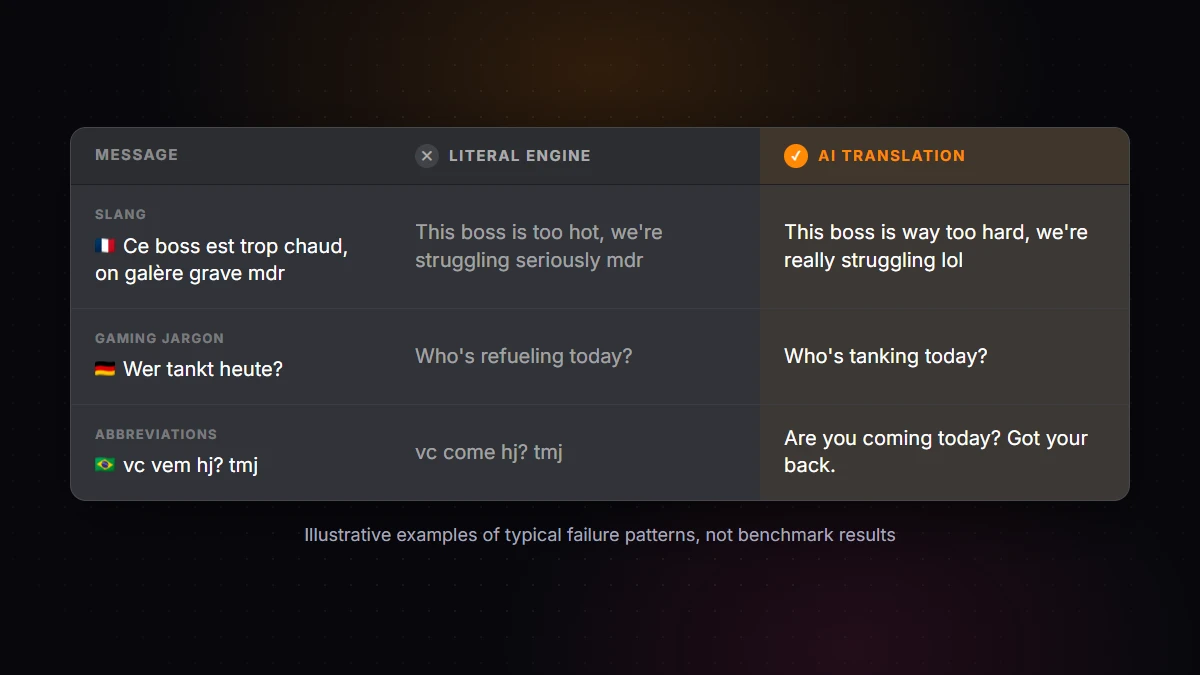
The examples in this section are illustrative. They're written to show typical failure patterns of literal, sentence-by-sentence translation, not output copied from a specific engine or benchmark. Modern engines get plenty of these right today, especially the most common slang. The problems show up in the long tail: new slang, niche game terms and heavily abbreviated messages.
Slang
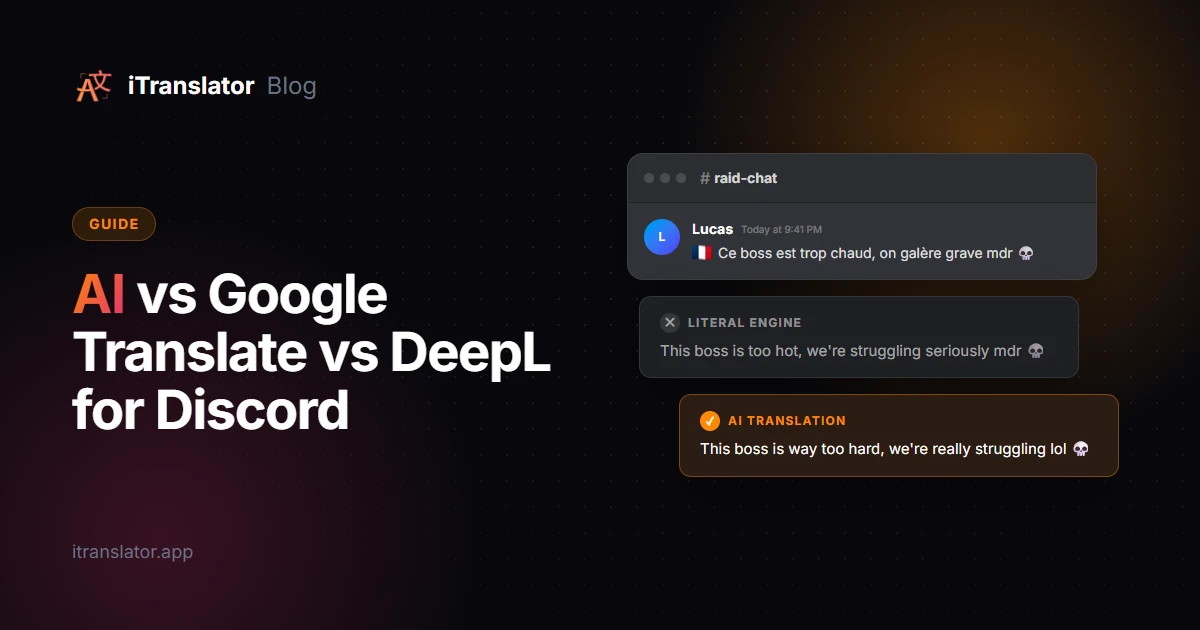
A French player writes: "Ce boss est trop chaud, on galère grave mdr".
A literal engine might render it as "This boss is too hot, we're struggling seriously mdr", because chaud literally means hot and mdr isn't a dictionary word. An LLM would more likely give "This boss is way too hard, we're really struggling lol". It knows chaud is slang for "tough" here and mdr is the French "lol".
Gaming jargon
A German raider asks: "Wer tankt heute?"
In everyday German, tanken means to fill up a car with fuel, so a literal engine might return "Who's refueling today?" In a gaming server, it obviously means "Who's tanking today?" An LLM that has seen plenty of gaming chat usually picks the right meaning, especially when it's told the server is about games.
Jargon breaks in the other direction too. An English "Protect the tank!" can come out in French as the military vehicle (char) instead of the role every French player simply calls tank.
Abbreviations
A Brazilian player types: "vc vem hj? tmj".
A literal engine might leave the abbreviations untouched and return something close to the original, which helps no one. An LLM would expand them: "Are you coming today? Got your back." (vc is você, hj is hoje, and tmj is tamo junto, roughly "we're in this together".)
Emojis and names
Both approaches generally keep emojis as they are, so "gg 🔥" survives either way. Messages made only of emojis don't need translating at all: iTranslator's auto-translation has an option to ignore emoji-only messages, so a string of 😂 doesn't trigger a translation.
Names are the bigger risk, for any engine. A guild called "Frost" or a character called "Hope" are real words, and a translator will happily translate them. An LLM is better at guessing that a capitalized word is a name, but the reliable fix is to protect those words before translation (more on that below).
Tone and formality
An English member writes: "Hey, can you send me the file when you get a sec?"
English has one "you". German, French, Spanish and many other languages have to choose between a formal and an informal form. A classic engine translating this line with no context might go formal in German ("Könnten Sie mir die Datei schicken…"), which sounds oddly stiff between friends. An LLM told it's translating a casual Discord chat would use the informal du: "Kannst du mir die Datei schicken, wenn du kurz Zeit hast?"
Some engines let developers choose: DeepL, for example, has a formality setting for languages like German, French and Spanish. But that's a setting chosen in advance, while an LLM can adapt its register to each message.
Context across messages
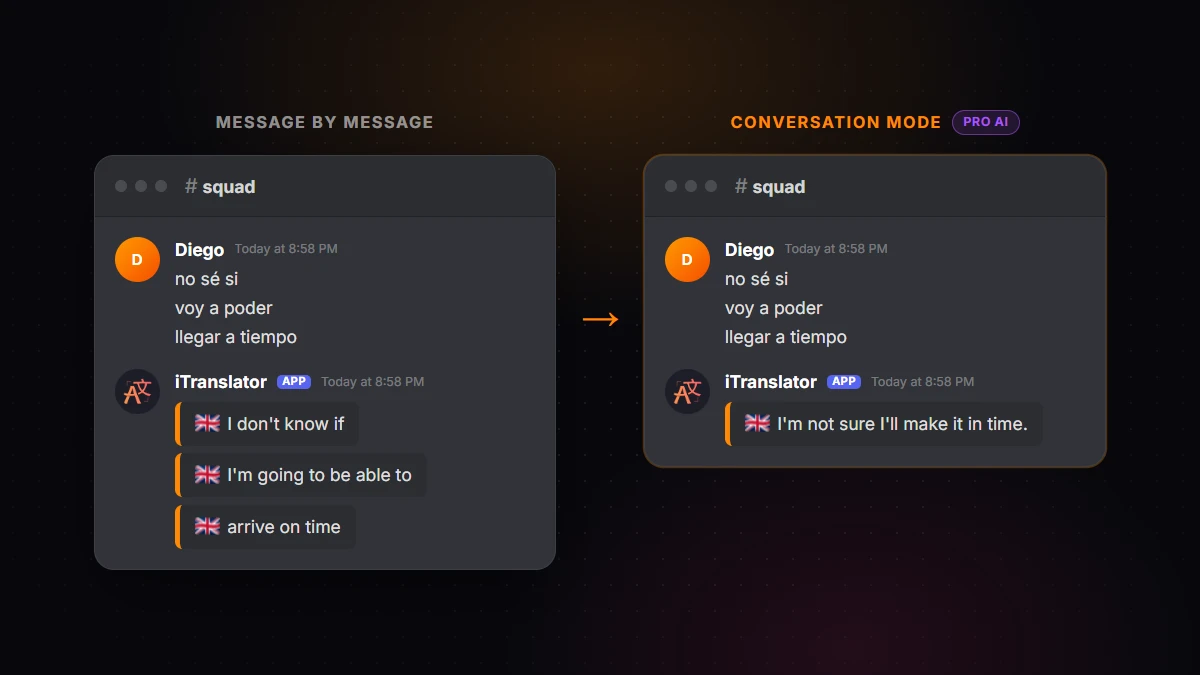
This is where classic engines are weakest, because, used the classic way, they translate each message in isolation. Picture a Spanish player typing quickly:
no sé si
voy a poder
llegar a tiempo
Translated one by one, you get three fragments: "I don't know if", "I'm going to be able to", "arrive on time". Readable, but choppy. In languages that drop subjects or put the verb at the end, fragments can become nonsense. Translated together, it's simply "I'm not sure I'll make it in time."
Context also decides pronouns. In French, elle est énorme can mean "she's huge" or "it's huge" (the map, la carte, is feminine). Only the previous message tells you which. Japanese routinely drops the subject of a sentence altogether, so a translator working one line at a time has to guess who's doing what.
That's exactly what iTranslator's Conversation Mode (Pro AI) is for. It waits a few seconds, groups a member's consecutive messages, and translates them together with the full context.
Speed and cost
Classic engines are very fast and cheap per character, which is why free translation tools can exist at all. LLMs are usually slower, and depending on the model and how much context is sent with each message, they can cost more per message. On a busy server translating thousands of messages a day, that can add up, which is why AI translation is usually a paid tier.
Reliability
LLMs have their own failure modes. They occasionally paraphrase more than they should, soften a rude message, or, if poorly instructed, answer a question instead of translating it. Classic engines are more literal, but also more predictable. Neither is perfect, and for anything critical (rules, legal text, moderation decisions), a fluent human should still have a look.
Classic engines vs AI translation: comparison table
| Classic NMT engines (Google Translate, DeepL, Microsoft, as most bots use them) | AI translation (ChatGPT-class model) | |
|---|---|---|
| Clear, complete sentences | Very good | Very good |
| Slang and memes | Fine for common slang, hit or miss beyond | Much better |
| Gaming jargon | Often literal | Usually understood in context |
| Abbreviations | Often left as-is | Usually expanded |
| Tone and formality | Default or fixed setting | Adapts to the conversation |
| Context across messages | None, one message at a time | Can use surrounding messages |
| Speed | Very fast | Slower |
| Cost | Low | Often higher, depending on the model and context sent |
| Predictability | High | Good, with occasional liberties |
Google Translate vs DeepL vs Microsoft: does the engine matter?
Between the classic engines themselves, the differences are real but smaller than the jump to an LLM. DeepL has a strong reputation for natural phrasing, especially between European languages. Google Translate covers the widest range of languages, including 110 added in a single 2024 expansion, which matters if your community speaks less common languages. Microsoft Translator is a mature option available in many Microsoft products.
Used the classic way, one message at a time, all three share the same limitation: they only see the message in front of them. If your server is full of slang and fragments, switching from one classic engine to another won't change much. Switching to AI translation will.
What iTranslator offers on each plan
iTranslator lets you pick the translation quality that fits your server, from free to AI.
| Plan | Price (ex VAT) | Translation | Useful extras for chat |
|---|---|---|---|
| Free | €0 | Free engine, 30 languages | 10,000 characters per server, reset for free every 12 hours by voting; 3 Text-Replacement rules |
| Premium | €9.99/month, or €8.32/month billed yearly | More accurate Premium engine, all 109+ languages | Unlimited characters, ignore words with <…>, 100 Text-Replacement rules |
| Pro AI | €29.99/month, or €24.99/month billed yearly | AI translation with an OpenAI large language model | Everything in Premium, Conversation Mode, voice transcription and text-to-speech |
In practice:
- Free is fine for clearly written chat and occasional translations. When the server runs out of characters, any member can vote for iTranslator and reset them for free with
/checkvote, once every 12 hours. - Premium is the sweet spot for most active multilingual servers: better accuracy, every language, no character limit, and the tools to protect words that shouldn't be translated.
- Pro AI is for servers where the chat itself is the point: fast gaming chat, roleplay, support channels, technical discussions, and language pairs where literal translation struggles most.
On Premium, ignore words keeps a game term, a character name or a server nickname untranslated: wrap it in <angle brackets> and the Premium engine leaves it as is. Text-Replacement works on every plan. It's a find-and-replace applied before translation, handy for expanding abbreviations or jargon an engine doesn't know, like turning "RSS" into "resources" (matching is case-sensitive and also applies inside longer words, so pick distinctive shorthand).
A subscription applies to one server, so you can add iTranslator to your server, start free, and upgrade only the servers that need it. The Premium page has the full comparison.
When is AI translation worth paying for?
Pay for AI translation when:
- Your chat is fast, casual and full of slang, like most gaming, anime and meme communities.
- Members type in bursts of short messages, which Conversation Mode groups together.
- Nuance matters: support channels, partnerships, delicate moderation conversations, technical discussions.
- You translate between languages that are structurally far apart, like English and Japanese or Korean, where context carries more of the meaning.
Stick with Free or Premium when:
- You mostly translate announcements, rules and event posts that are written clearly.
- Your server is mostly in one language and only needs occasional translations, which flag reactions or the right-click Translate Text handle well.
- Your translation volume is low and "understandable" is good enough.
A sensible path: start on Free, move to Premium when you regularly hit the character limit or need more languages, and go to Pro AI only if members still say translations sound robotic or miss the point.
How to get better translations with any engine
- Set the source language in your auto-translation configuration when you know it. Short messages are the hardest to detect.
- Protect names and terms with
<angle brackets>(Premium), and use Text-Replacement (every plan) to expand abbreviations the engine doesn't know. - Skip what doesn't need translating. Turn on "ignore emoji-only messages", and put
no-translatein the topic of channels where flag reactions and role translation shouldn't run. - Group fragments with Conversation Mode on Pro AI. A delay of 2 to 3 seconds works well.
For the full setup, see how to auto-translate a Discord channel. If you're still choosing a bot, our comparison of the best Discord translation bots covers the options.
FAQ
Is DeepL better than Google Translate for Discord?
Both are strong on well-written sentences. DeepL is often praised for natural phrasing in European languages, while Google Translate covers far more languages. For Discord chat, the gap between them is smaller than the gap between either one and an AI model, because slang, jargon and fragments trip up both.
Is ChatGPT better than Google Translate for translating chat?
For informal chat, a ChatGPT-class model usually produces more natural translations because it understands slang, tone and context. Classic engines are faster, cheaper and more predictable, and they're perfectly adequate for clear sentences.
Which translation engine does iTranslator use?
The free plan uses a free translation engine, Premium uses a more accurate premium engine, and Pro AI translates with an OpenAI large language model. Pro AI also adds Conversation Mode, which translates a member's consecutive messages together.
Does AI translation make the bot slower?
An LLM generally takes a little longer to produce a translation than a classic engine. With Conversation Mode, iTranslator also waits a short delay you choose (up to 10 seconds; 2 to 3 works well) to group messages, trading a brief wait for much better context.
How do I stop a bot from translating game terms and names?
On Premium, wrap them in <angle brackets>: the Premium engine leaves them untranslated. On any plan, Text-Replacement (3 rules on Free, 100 on Premium) rewrites terms before translation, which helps when an engine keeps misreading an abbreviation.
Does iTranslator store the messages it translates?
iTranslator doesn't store your messages in a database. It translates them on the fly, sending the text to your plan's translation engine (an OpenAI model on Pro AI). If some channels should never receive translations or trigger flag reactions, add no-translate to their topic.
Break the language barrier on your server
iTranslator translates every message automatically in 109+ languages, so everyone can chat in their own language. Set up in 2 minutes.
Add to DiscordFree to start · No credit card required